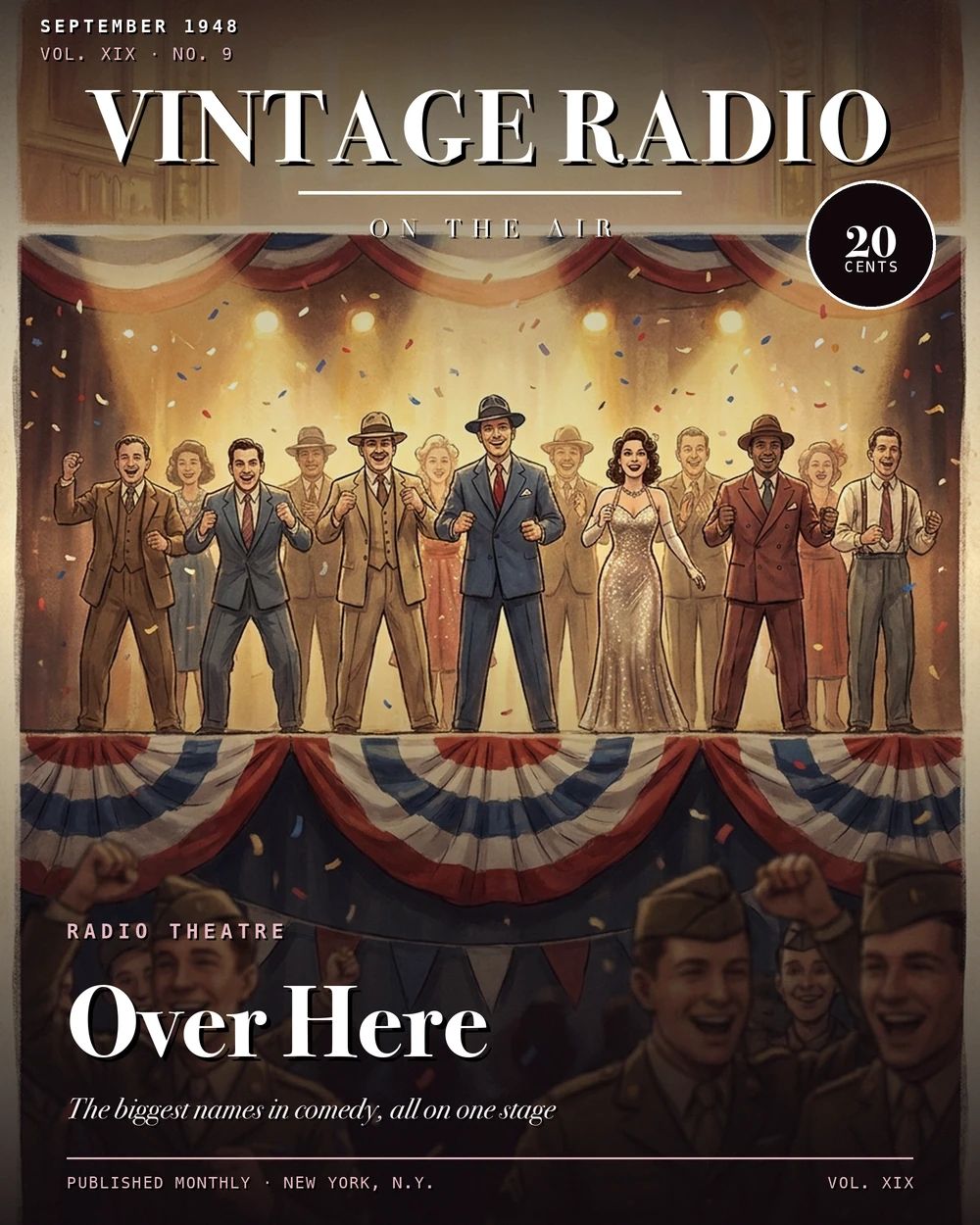
Over Here
A Wartime Show With a Short Run
Over Here ran for less than two months — the earliest surviving broadcast is dated December 12, 1942, and the last known episode aired January 9, 1943. That brief window puts it squarely in the first full year after Pearl Harbor, when American radio was pivoting hard toward the war effort and variety programming was one of the primary vehicles for keeping morale up on the home front. The show blended music, comedy sketches, and patriotic messages, and it pulled from a deep pool of Hollywood talent to do it. What makes it interesting today isn't its longevity — it has none — but rather the snapshot it provides of wartime entertainment in its earliest, most urgent phase.
The program appears to have aired on NBC's Blue Network, based on a network identification captured at the start of one surviving episode. The Blue Network was in the middle of its own transition during this period, and wartime variety programming like Over Here was a staple of its schedule.
The Names That Showed Up
Six episodes survive, and the guest list across those six broadcasts is striking for such a short-lived program. Jack Benny appeared alongside Mary Livingston — his real-life wife, born Sadie Marks — on the December 26, 1942 broadcast. Milton Berle turned up across two episodes, paired with film actress Linda Darnell, whom Berle reportedly dated at the time. Susan Hayward, then a busy Paramount contract player, appeared in a war-bonds capacity, consistent with her wartime radio work supporting the effort on the home front. Charles Laughton, whose mellifluous speaking voice had already made him a sought-after radio presence through programs like Lux Radio Theatre and Mutual's Three Ring Time, took a slot on January 2, 1943. And the final known broadcast, January 9, 1943, featured Groucho Marx alongside singer Jane Froman.
That last pairing carries some weight in retrospect. Froman, one of the top-rated radio singers of the era, was actively performing on wartime radio and USO shows at the time. Just six weeks after that Over Here broadcast, she was severely injured in a plane crash on February 22, 1943, while en route to a USO tour in Europe. Her appearance on this program is one of her last documented radio performances before that accident.
What the Show Was Doing
The format followed the variety template common to wartime radio: comedy sketches that played on military life and the civilian experience, musical segments featuring popular songs, and an underpinning of messages meant to reinforce unity and support for the war. Susan Hayward's appearance specifically carried a war-bonds dimension, which suggests the show was doing some of the direct promotional work the government was encouraging broadcasters to take on during this period.
The comedy leaned into the everyday strangeness of wartime — soldiers adjusting to military life, families navigating rationing and absence, the general upheaval that Americans were living through. It wasn't pointed political commentary; it was the kind of humor that acknowledged shared difficulty and tried to lighten it.
What Survives and What to Know About It
All six surviving episodes have audio quality issues of one kind or another. The two Milton Berle and Linda Darnell episodes are noted as poor sound, the Susan Hayward episode is scratchy, the Jack Benny and Mary Livingston broadcast skips at the beginning, and the Groucho Marx and Jane Froman episode has a bad ending. Only the Charles Laughton episode escapes a specific quality warning in the catalog notes. For a show this old, recorded under wartime conditions when resources and attention were directed elsewhere, none of that is surprising — but it's worth knowing going in.
Over Here is not a show with a legacy in the way that longer-running programs built one. There's no defining cast, no signature character, no single episode that gets cited as a classic. What it is instead is a genuinely rare piece of the wartime radio calendar — a short-lived program that happened to capture several major entertainers at a specific, charged moment, and whose recordings survived when plenty of others from the same period did not.